

Hanna Ljungqvist — after working at Volvo Penta for more than a decade in her early career, and most recently serving as vice president and head of Volvo Trucks in India and Indonesia — recently made her return to the marine industry. She is head of the Volvo Penta Marine Business and a member of the Volvo Penta Executive Group.
Ljungqvist has a master’s degree in industrial design engineering from Chalmers University of Technology in Gothenburg, Sweden, and entered the Volvo Group International Graduate Program in 2008. Since then, she has worked in various commercial and technical roles within AB Volvo.
During her career at Volvo Penta, she has held various senior management positions within the marine business, including product and business development. Most recently, she served as vice president, Service Market Marine, where she headed global marine parts and service, and was responsible for growing sales and securing service and support.
Ljungqvist sat down with Soundings Trade Only during Metstrade in late November to discuss her new role, the innovation culture at Volvo Penta, sustainability in the marine industry and more. This interview has been lightly edited for clarity and length.
Please tell us about your personal and professional backgrounds.
I’m a native Swedish person, just like Volvo is as a company. I have been working at Volvo Group my entire career. I’m an engineer. I have a master’s degree in engineering. The heart of Volvo is in Gothenburg, so our paths crossed early on during my time in engineering studies.
When I started at the Volvo Group, it was on the truck side. Then, after a few years, I entered into Volvo Penta. I have spent most of my years at Volvo Penta, working with everything from product planning, product management, strategy, business development and also in the commercial operations service market side.

You just transitioned from trucks at Volvo Group back to Volvo Penta. Tell us about that career move.
I’ve been with Volvo a total of 18 years, of which 12 were at Volvo Penta. I started on the truck side with technology, and in research and development. Then I went to Volvo Penta, where I worked for 12 years. Most recently, I was in the truck business, heading up Volvo truck operations in India and Indonesia. Then, just recently, I returned to Volvo Penta.
What was it like working at the truck group? How did it differ from marine?
Volvo Group is a very diverse business. The trucking component, in terms of the core values and the culture, it’s still Volvo Group. One difference is that we sell a finished product on the Volvo truck side. With Volvo Penta we are largely selling products and components that go into a finished product: a boat.
In terms of having direct sales and that direct interaction with the fleet owners — the mining operators in India and Indonesia — the truck business is much, much bigger than Volvo Penta. It’s a huge business.
If you look at the total Volvo Group, about 50% is the truck business, while Volvo Penta is a smaller percentage of that, which means that the presence in the markets, the number of dealers, customers, the size of the portfolio and investments, it’s a much different scale between the two companies. Then there’s the industrial equipment side of Volvo. There are definitely things we can learn and benefit from being smaller and nimbler at Volvo Penta.
Is there any collaboration between the two groups?
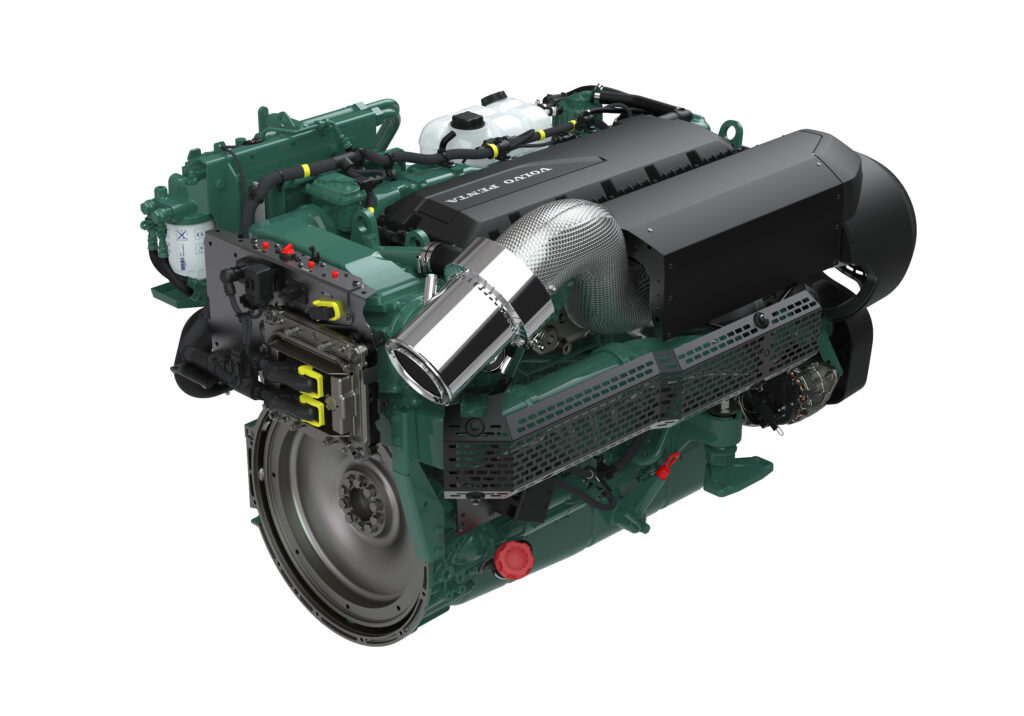
I think there are a lot of benefits for us to be part of the larger Volvo Group. If we take the example of our D8, D11, D13 and D16 engines, that base engine is produced for all of the group. Then Volvo Penta takes those core engines and marinizes them with the marine-specific knowledge. Volvo Penta is still using that base truck engine design, where the group invests a lot of research and development money. Having the larger truck group also allows us to leverage the footprint of manufacturing scale. We leverage the capability to manufacture hundreds of thousands of engines to increase efficiency and lower overall cost.
It is the same model when it comes to our IPS drives and the engine transmission business. Volvo Group is leading in transmission technology, so that know-how, competence and industrial footprint, we can leverage and then add on our marine side.
The third thing that I would really stress is our global footprint with logistics or spare parts, which means that we have an extremely good availability and reach with our dealers — both for trucks and marine.
How do economic headwinds like inflation, high interest rates and tariffs affect your business?
It’s a tough market right now, and no one in the marine industry can really say anything differently. We know that consumers are more cautious due to this uncertainty — the wait-and-see sentiment — and we know that in other consumer industries, this is a challenging market all around.
We see this as a cyclical business. We’ve seen ups and downs many times, and we know the market will come back. The question is when and how quickly, but as Volvo Penta, we know that it will come back. That’s why we keep investing in our product portfolio. Because we want to position ourselves for the market when it comes back.
Right now, it’s about really being close to our customers, understanding what’s going on and, of course, efficiently managing the operations and looking for all the opportunities we can find, wherever they are.
About seven years ago, all we heard was, everything’s going to go electric. That didn’t happen. Where do you see things headed in this regard?
First and foremost, sustainability is the core of Volvo Penta and all the Volvo Group. It has always been this way. We are committed to leading the industry into more sustainable solutions. What is not clear is the pace of it. Some years back, there was an expectation of a very quick ramp-up and a quick transition into all-electric propulsion. Now we are seeing a slowdown, even in electric automobiles and trucks. From our side, we do not see one solution fitting all marine applications. We see a mix. It could be sustainable fuels for some applications. It can be hybrid for others, or fully electric in others.
For marine, we see a good use case in something like all-electric ferry boats. With that model, you have a boat going back and forth between point A and point B, where you can secure the charging, optimize how much battery capacity you need to do that trip, how many times a day you need to recharge. But when you have higher speeds, more unpredictable routes, then fully electric will not be an ideal application of that technology — probably not even a decade from now. We believe in and are investing in all of these technologies, but the real question is: How can you make the boat hull and the propulsion more efficient and sustainable?
Tell us about sustainable fuels like hydrotreated vegetable oil.
HVO is fully compatible or comparable with diesel fuel, for example, but it’s made from organic products. In Sweden, it’s sourced mainly from the forestry industry, but it could also be manufactured from frying oil and other waste products. There are some building blocks in other materials, such as soybeans, as well, that can be translated into fuels. Our marine diesel engines can run on HVO.
Sustainable fuels are already a big thing for aviation, but the trick for marine use is the availability of it. There are not enough large-scale industrial production factories for HVO anywhere on the planet. There is a whole system that has to be set up to distribute the fuel, which doesn’t currently exist. People put fuel in their cars and boats and don’t think about what it took to make it and get it to the pump. It’s complex.
Tell us about Volvo Penta pushing into larger yachts with the IPS professional platform.
We launched IPS as a groundbreaking innovation 20 years ago. We have 40,000 IPS boats out there today, and we are now making it available for larger yachts and commercial vessels. With the IPS professional platform, we took the next step up to 35- to 55-meter vessels — both yachts and superyachts — as well as in marine commercial applications. The first installation was in a marine commercial. Heavy-duty operations have been running 5,000 hours without any problems, which I think is a very good proof point.
We are now bringing all those benefits from IPS into bigger vessels with durability, energy efficiency and sustainability. The platform gives us up to 30% better fuel consumption, 40% longer range and 20% higher top speed when compared with the same level of inboard horsepower. Adding on to that, builders can do a completely different layout when they utilize IPS.
As a leader, how do you empower the innovation culture at Volvo Penta?
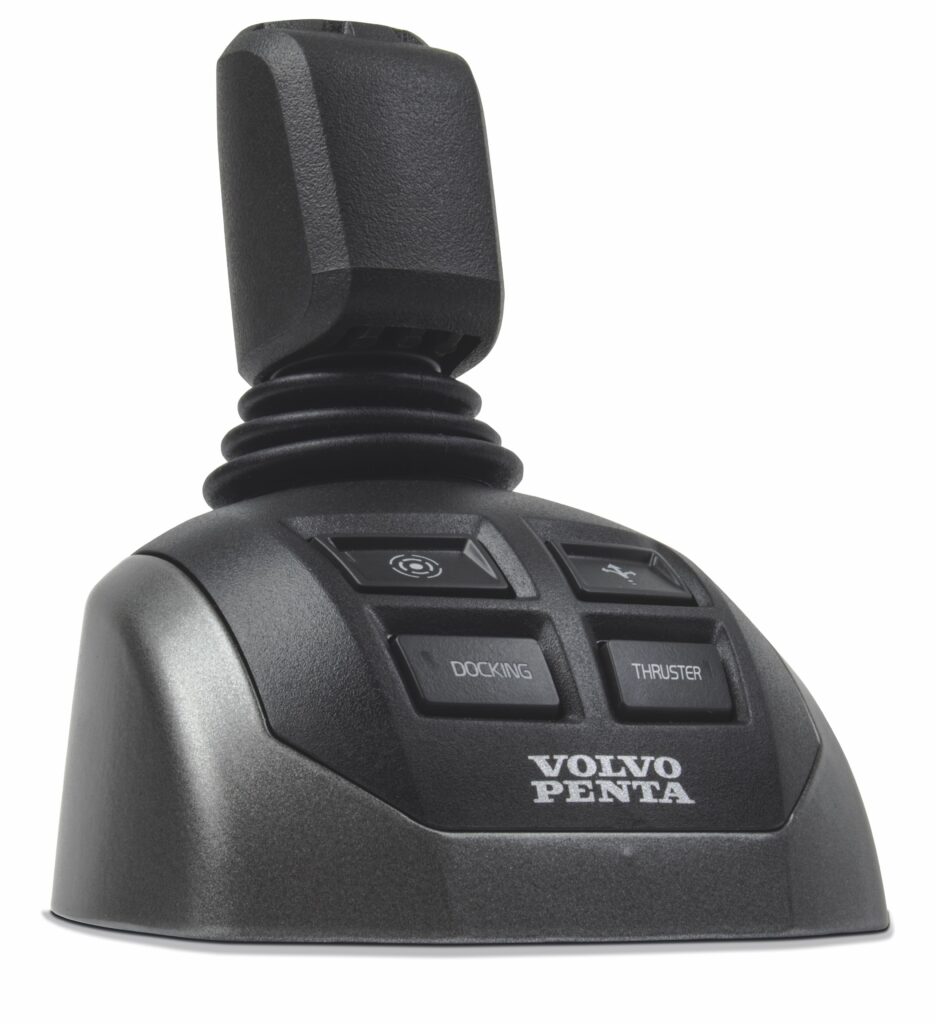
I would say that we have an extremely strong, innovative baseline to build from. We usually say that innovation is in our DNA, and it’s really true. Volvo Penta has introduced many groundbreaking innovations since the Aquamatic sterndrive many, many years ago. IPS control is another one, joystick control is another, and we’ve brought those technologies to assisted docking and dynamic positioning. I can tell you there is no lack of ideas on what we could be doing when it comes to our team.
In our development teams, our talented people get all these good ideas on the table, and then we align everyone with the vision. Then we need to adapt and get the product to our markets. Innovation is such a part of what we do that it does not require that much of active work to make it happen. The key is also to stay close to the customers and figure out what they’re really looking for or need.
Finding and keeping trained service technicians in the marine industry is a challenge. What is Volvo Penta doing to address the workforce issue?
Whether it is trucks or marine engines, it is difficult to find skilled technicians all across the world. The trick is to attract and keep them, but also to give them the tools to be efficient so they can serve as many customers as possible with their time and knowledge. We are relentlessly working with making these things accessible with confidence development, and investing in digital tools to make their lives easier and more efficient.
What is the best part of your job?
The most rewarding thing for me is meeting our customers. I always get so much from talking to them, and learning how we can make our products better and contribute to making boating easier, better and safer. I also like challenging the boundaries of what we can do, and how we can make boating more accessible and sustainable.
What are the most challenging aspects of your job?
I think it’s the questions like: What are the things we should start with right now? What are the things that come later that will actually have an impact in the market? So that prioritization and the implementation of the pace of those things, I would say, is the most difficult.
For example, how quickly should we ramp up sustainability efforts like alternative fuels? Then we might talk about automation features. We need to decide at what pace and what technology to use to get there.
Can we expect new things in 2026 from Volvo Penta?
You can expect some new things coming. I think the bigger ones will be by the end of 2026, but we have already teased a little bit, and that it’s related to the hybrid path.
What are you doing with hybrid right now?
We are in testing. We’ve had some platforms that we’ve run and learn from, and now we are refining those concepts and testing them. We are working with a couple of key customers, both on the commercial side as well as on the yacht side.
What are you looking forward to in 2026?
We have been on an exciting journey for many years now to establish our products in the yacht segment and superyacht segment. The first step in that journey was having the IPS professional platform in the water in the Sanlorenzo SX120. That is one of our focus areas, and we have good traction and very good interest from the industry. Then, at the same time, we’ll continue investing in our boat segment, which is still core for us.
We are also asking what steps we need to take to bring our experience and solutions to the next level. Marine commercial is also a business that we have been aiming to continue growing, and we’re also now getting good traction there. We have very good momentum, though 2026 likely will be quite challenging in other ways.