
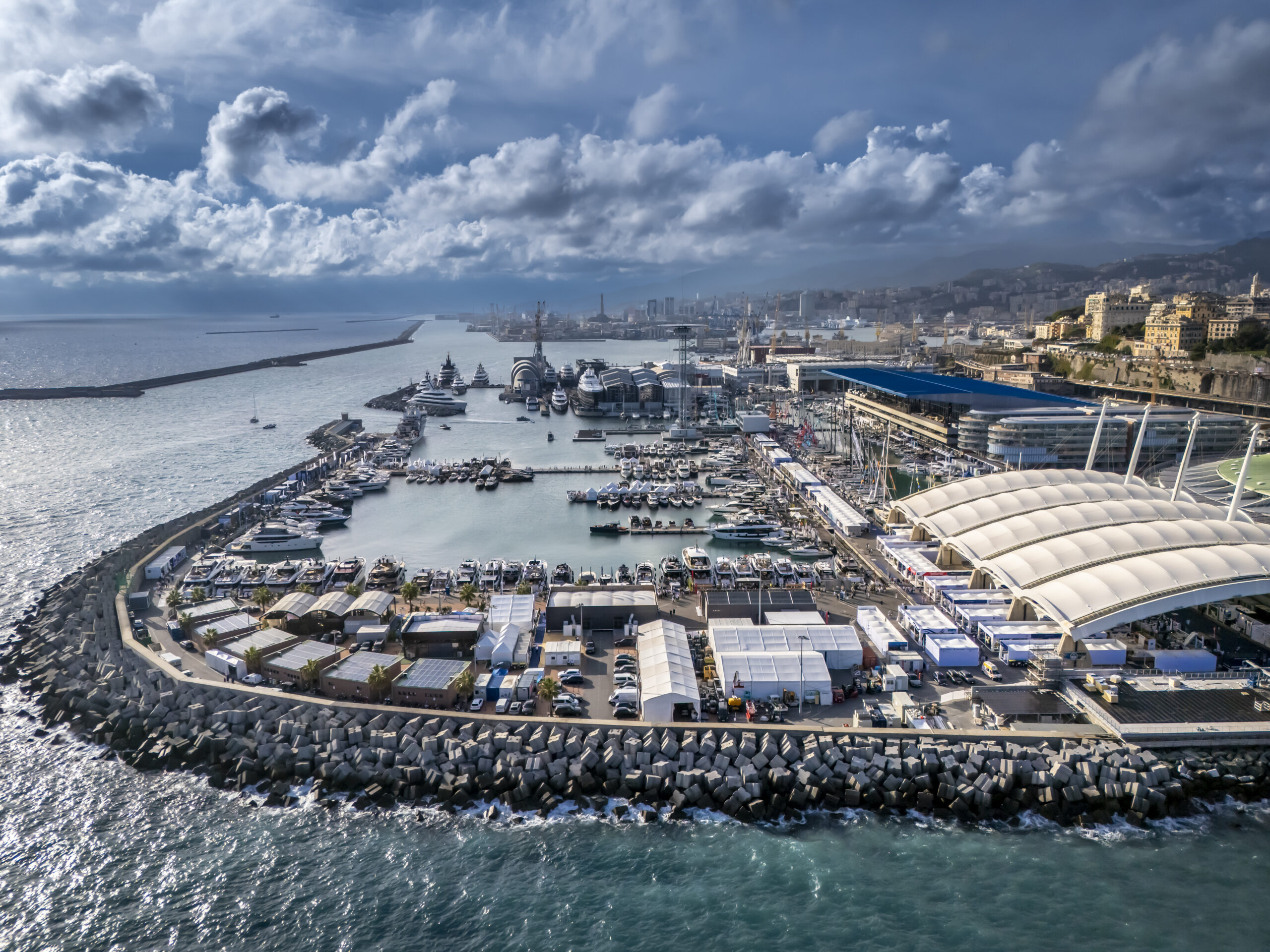
The Italian marine industry is a powerhouse. As reported at the Genoa International Boat Show in September, Italian yacht and superyacht builders held half the world’s orders in 2024, with 572 units under construction. Its marine industry also reported record revenues in 2024 of about $10.4 billion, up 3.2% year-over-year. The industry contributes about $8.65 billion, or 3.4%, of Italy’s GDP.
As I walked the halls and docks of the Genoa show, I found history and innovation side by side. Take, for instance, 105-year-old Razeto & Casareto. This fourth-generation, family-owned manufacturer has long built locks and fittings. Today, it is known for door locks, handles and electronic access systems that blend traditional craftsmanship with lighting, security and on-board management.
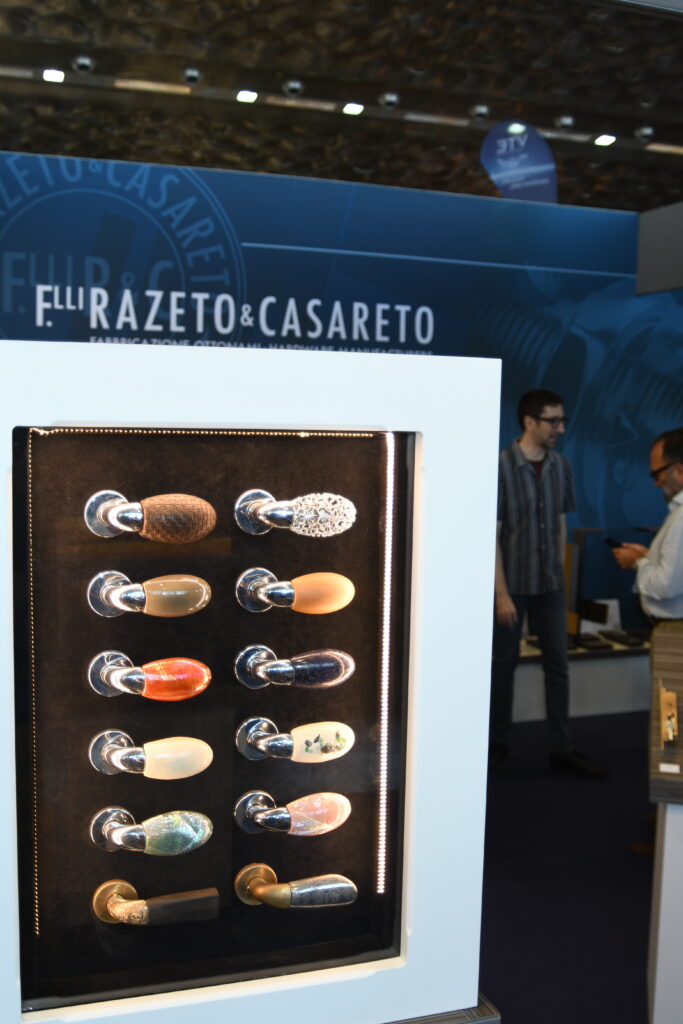
“I would highlight two products that embody the innovative spirit of the company,” says Giangi Razeto, innovation and lab director. “The first one is called QuadraLed, the second one is OSSH. Both are smart access integrated systems with illuminated handles. Both use the patented cable-free power and data transfer system to bring power and data from the frame to the door to illuminate the handles and give safety or management information.”
Razeto says the company developed OSSH for fire doors on cruise ships. “When fire doors are shut because of a fire, the handles take information from the fire detection system and light up green on the side of the fire and red on the other side in order to direct passengers to safe escape routes,” he says.
QuadraLed adapts the technology for yachts and cabins. “It features different applications such as general alarm, courtesy light, emergency light in the event of a blackout,” Razeto says. “QuadraLed also features the Esi antimicrobial system. The surface of the handle cannot be contaminated by fungi, bacteria and viruses. The system is certified by RINA to stop the spread of pathogens.”
OSSH and QuadraLed have received several international awards. Razeto & Casareto also engineered an electronic backbone that allows smart handles to integrate with on-board electronics. The OSSH network communicates through Modbus TCP/IP for lighting, smoke detection, safety management and digital switching systems.
Configurations range from emergency-light applications to zone control units. “Our luminous handles management software lets operators oversee every OSSH handle on board,” Razeto says.
“We have been spending the last 10 years trying to pioneer the hardware integration with the systems on board, either for commercial or leisure boats,” he adds. “Of course, design is a plus when it comes to superyachts and luxury, so we tried to meet or foster the trends. One of these trends suggests that hardware should disappear; this is why the chameleonic design of QuadraLed reveals its presence only by the light.”
New Materials, New Partnerships
At the Synteak booth, the Italian company had a new product working with U.S.-based DEKit. “DEKit in the U.S. was introduced to Synteak in Italy via Evercor in Australia,” says DEKit CEO Dan Brauser. “That partnership was forged when DEKit recognized the innovation Evercor had with its cork-composite hybrid decking material. Slightly after DEKit and Evercor linked up to introduce the innovative Evercor decking material to the North American market, Evercor met Synteak and pursued a similar distribution relationship with them to introduce Evercor to Europe.”
From there, collaborations began on production methods, creative approaches, distribution strategies and more. As DEKit looked at further expanding its product catalog, Brauser says, the company spoke with Synteak’s team about synthetic teak materials. The result was E-Dek Pro.
At its core, E-Dek Pro is a polyurethane resin-based synthetic teak atop an EVA foam layer. “The resulting product is multicolor and routable, which provides the aesthetic and customizable attributes that the market has come to enjoy in foam decking solutions,” Brauser says.
The product has a realistic look and feel, and maintains the soft, anti-fatigue properties underfoot that boaters like. The resin-based top layer provides a protective barrier against light amplification and thermal instability, two of the biggest downsides to some foam decking. “Initial market response has been extremely positive from both boatbuilders and retail customers alike, with customer applications ranging from smaller tenders to larger yachts and everything in between,” Brauser says.
Building New Platforms
The Genoa show had more than 1,000 boats on display, including Mar.Co’s E-Motion 44, a luxury RIB with foldout hull sides. Andrea Zamuner, Mar.Co’s sales and marketing manager, says the E-Motion 44 pushes the boundaries of RIB design. I met him at the dock to see the E-Motion 44, and he was quick to mention others with key roles in the E-Motion 44 project, including Federico Gerna and his team and Giuseppe Capruzzi, all from Italy.
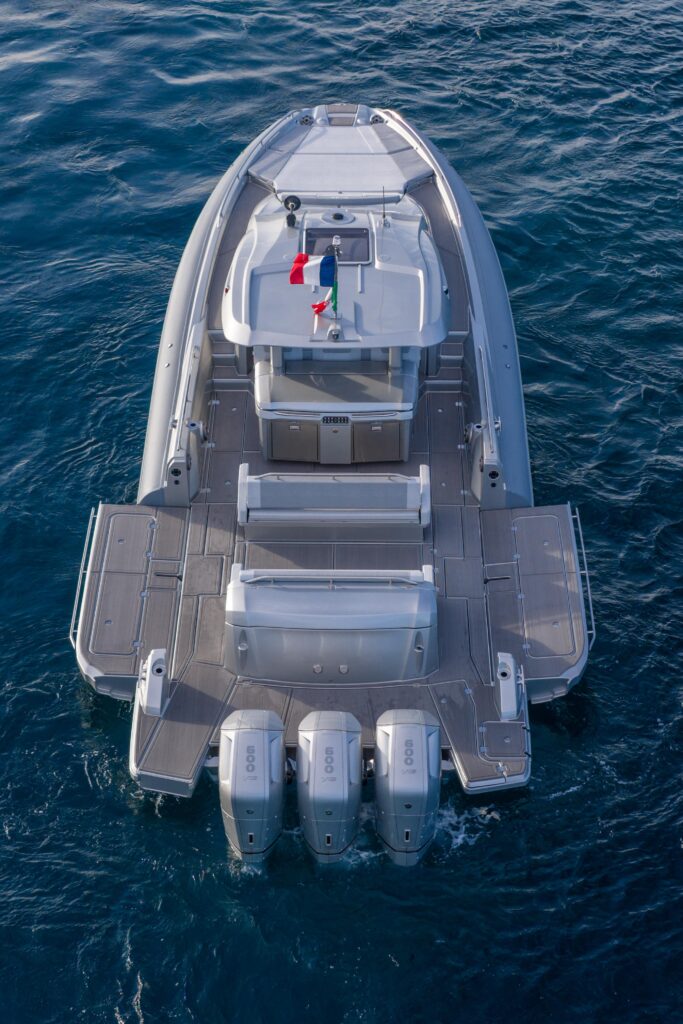
“The folding platforms, paired with a very generous table and benches, allow us to maximize convivial moments,” Zamuner says. “The boat offers an incredible amount of extra space and a more direct contact to water. On top of that, when extended, the two fold-down, side platforms also help reduce rolling while at anchor.”
The E-Motion 44 has a beam of 14 feet, 11 inches with the hull sides closed, expanding to 18 feet, 5 inches when deployed. Below deck, the layout includes an owner’s stateroom, guest cabin and full head.
Zamuner says the foldout sections rely on an electric-hydraulic system engineered to withstand the stresses of offshore performance. “The main challenges we faced in this area regarded the behavior of the platform during navigation, when they are closed and subjected to large stresses, as the E-44 can reach up to 60 mph,” he says.
The builder allows owners to select engine configurations and finishes. Hull No. 1 has triple 600-hp Mercury Verado V-12 outboards and a striking metallic silver livery. Engine options range from triple 425-to quad 500-hp outboards. Zamuner says interest in high-performance RIBs is growing internationally, particularly in the United States.
“Mar.Co would be honored to enter the U.S. market, which is the most important boating market in the world,” he says. “We believe the E-44 has all the necessary characteristics — power, seaworthiness, on-board space, build quality — to attract interest from the American market.”
Forging the Future
Out on the docks, Quick Group showcased the MC2 Quick Gyro stabilizers. The range includes two series: DC Series (12-volt DC-powered and integrated driver) and X AC Series (powered with external driver control). “For the DC 12V range, it starts with the X2 and 3 models, which are only 12V, and goes up to the X13, which is the largest 12V unit we offer. All other models are either 220V AC or 110V AC,” says Andreas Karlsen, chief commercial officer of Quick Group. “The X2 and 3 are the most compact MC2 Quick Gyro stabilizers currently available on the market, making it possible for smaller boats to enjoy the same comfort and functionality as larger yachts.”
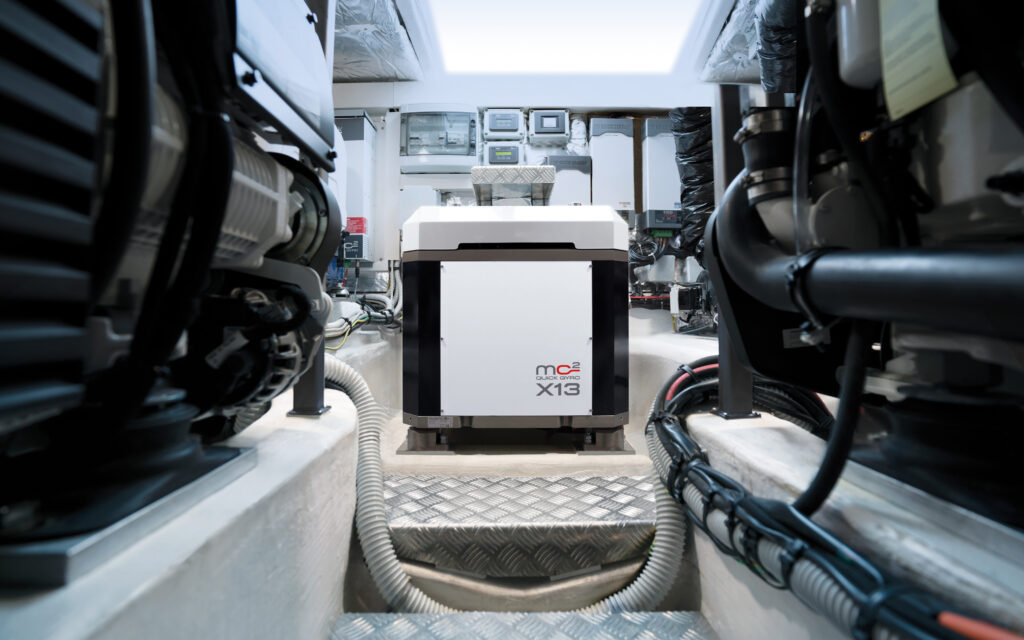
By relying on natural dissipation instead of water cooling, the unit requires fewer components, shorter installation time, smoother servicing and quicker turnaround, he says. The entire unit is designed around simplicity: easy to install, quick to reach stabilization speed, no secondary systems, low maintenance and reduced overall cost — both for purchase and ownership, Karlsen says. By using natural dissipation for cooling, there is no need for a seacock, meaning no additional holes in the hull, no seawater pump and no extra current draw for cooling.
“Our design philosophy is always centered on the end user,” Karlsen says. “Awareness of stabilization — whether via fins or gyros — is steadily growing, and with current trends, we expect more boatbuilders to start including stabilization systems in their standard equipment lists. Stabilization may well follow a similar adoption path to air conditioning, which was once considered a luxury but is now standard.”
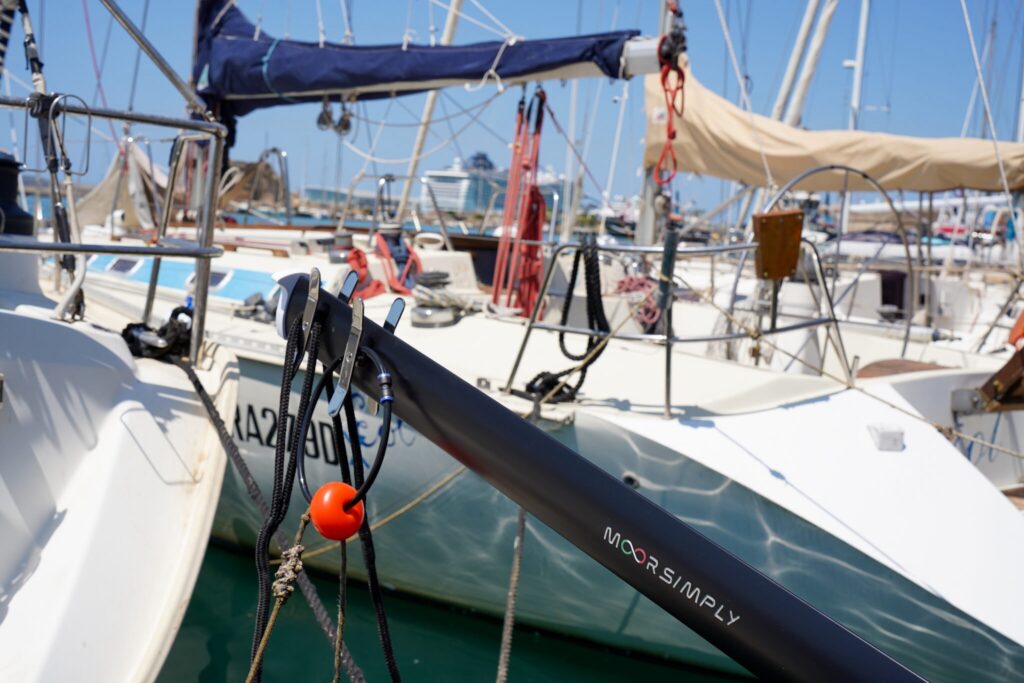
Maneuvering through the show’s crowded outdoor walks of the Sailing World section, I visited the Moorsimply company, whose remote-controlled docking assist arm makes docking and tying off easier and more comfortable by extending lines out to approaching boaters on command. Moorsimply first appeared at the Genoa show as a start-up a few years ago and now has various models available. On the model I saw, the extendable arm had a solar module to power the battery, and a cord if shore power is preferred.
Startup companies at the show included ElectriFly, which won the Special Prize for Outstanding Talent in the Design Innovation Awards this year. Its technology combines passive and active magnetic levitation to support rotating components in propulsion units. The electromagnets are current-controlled and, the company says, can enable precise trim control. The tech allows frictionless operation and has a scalable design adaptable to many marine applications. By eliminating seals, bearings and lubricants, the system avoids wear and maintenance on those parts, as well as leakage of potentially polluting materials.
ElectriFly was, at the time of the show, finalizing the assembly of its new prototype, says CEO and co-founder Mauro Bonfanti, with testing scheduled to start later this year. “We are also preparing our seed funding round [opening in December 2025] to scale development and start the first pilot applications with industrial partners,” he says.
The week after the Genoa show, Italy’s Cantieri di Pisa signed a partnership with Genoa-based T. Mariotti shipyard, allowing construction of superyachts larger than 164 feet. The first model is expected to be the 230-foot Super Polaris 70.
The Italian marine industry keeps moving into the future — by creating it.