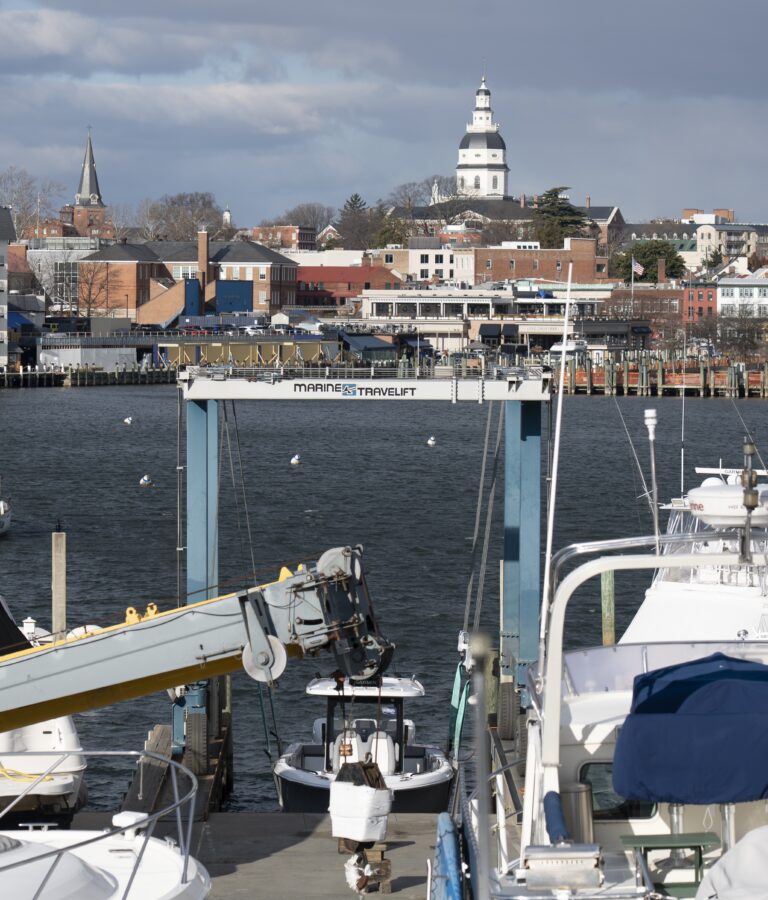


I took a hike around some local boatyards recently to snap photos for a feature you’ll find on Page 34. It’s about Marine Travelift, the company whose name is synonymous with boat lifts and hoists worldwide.
Though I haven’t owned or lived on a boat in more than 25 years — friends’ boats are the best boats — the morning boatyard trip stirred up all sorts of good memories. For about 11 years during my 20s and early 30s, I lived aboard and fixed up two sailboats. I also worked in the Chesapeake Bay’s marine industry, serving wholesale boatyard and boatbuilder accounts with marine supplies.
Every yard has a heartbeat and a soul. Some of them are eclectic and eccentric, while others are all business, organized and run like well-oiled machines. I always leaned toward the former. The smaller, family-run yards had fewer rules, less prying eyes from management, and a community of customers and boat owners who just made things fun. Need a ladder? Sure, borrow mine. Out of sanding discs? Here, take a few and get the replacements back to me anytime.
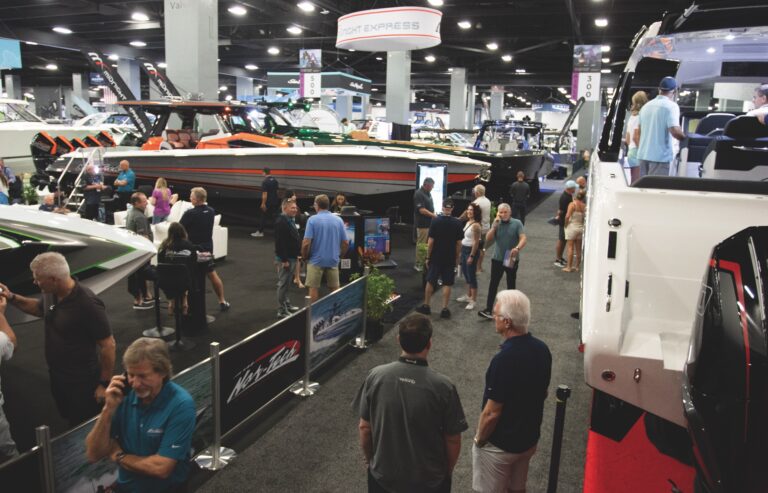
I remembered that cooperative spirit as I drove through four yards near my home, and it got me thinking about the marine industry as a whole. Specifically, it had me reflecting on the Marine Retailers Association of the Americas’ Dealer Week, which ran in mid-December in Tampa, Fla. If you want to see marine industry teamwork on a large scale, gather several hundred dealer members and their employees together in one spot and watch the camaraderie bloom.
That team spirit was alive in the panel discussions and workshops, with one discussion that I felt united the entire room more than any other. It was about the future of marine retail and the huge elephant that’s been sitting on dealers’ shoulders since the end of the pandemic boat-buying boom: pricing transparency.
We live in a world where you can go online, find a vehicle, agree on a price, arrange financing and have it delivered to your home without almost no human interaction. I bought my last vehicle in this manner, and the experience far exceeded my previous car-buying experience, which involved haggling and heavy-handed sales pitches. And I am here to tell you this is the way the current crop of boat buyers is expecting to do business with dealers in the future.
If you need some proof that I’m right about that, read MRAA president Matt Gruhn’s column on Page 18. Gruhn clearly lays out what is happening, and what we as an industry need to do. You will learn that with artificial intelligence bots combing the web, “call for price” is not going to work for much longer.
Contributing editor Kim Kavin furthers this reporting on Page 30, speaking with a handful of industry veterans in the dealership, boatbuilding and retailing sectors.
This issue also aims to offer insight into the international scope of the marine industry. I thoroughly enjoyed interviewing Barton Marine CEO Suzanne Blaustone for this month’s Q&A. After getting to know her better over dinner and drinks in Amsterdam during Metstrade last year, I knew she would offer a smart perspective on running a small, nimble global brand amid tariffs, Brexit, inflation and uncertainty. You can read the interview starting on Page 8.
Senior editor David Conway profiles another U.K.-based company beginning on Page 38. Scanstrut, which has facilities in Devon, U.K., and Westbrook, Conn., is focused on solving boaters’ real-world problems with clever, innovative gear.
Switching gears, some of you may know that we recently conducted an expansive reader survey. We received a healthy response with lots of good feedback about what we’re doing right, what you’d like to see change, and the sort of content folks want to see in the magazine every month.
Overwhelmingly, readers said they want to see more content focusing on the dealer angle — both aftermarket retailers and boat dealers. Last month, we printed our first Dealer Spotlight column, and it returns this month on Page 28. It’s an interesting way to see what successful dealers are doing that works, and things they’ve tried that didn’t.
Toward the back of the book, take a gander at our economy and jobs reports. They’re packed full of context from marine industry analysts and participants, and are an easily digestible way to catch up on where things stand during uncertain economic times and an unpredictable job market.
While you’re doing that, I may go back to one of those boatyards I visited. There were a few “For Sale” signs that need further investigation. Let’s see how transparent the pricing is.