Some of the most innovative, industry-influencing boats got their start in some of the least-attractive places. Sometimes that meant an old barn in the middle of a field. Or a crusty boatyard shed. More than a few household garages have been used to build boats or start companies that ended up defining a market segment.
For electric boat startup Volare Boats, that place is a cinder-block building surrounded by a discarded pontoon boat, a rusty backhoe, old batteries and empty resin drums. It’s all set beneath strands of Spanish moss that dangle and dance in the wind from live oak trees off a sandy back road in Summerville, S.C., just north of Charleston.
I’m riding in the pickup truck of Volare’s chief operating officer and co-founder Dustin Tupper when the company’s new headquarters come into view. The 4,000-square-foot structure is a bit shocking at first sight. “We’re all about running lean and getting into full-scale production right now,” Tupper says. “Sometimes that’s means trailering a prototype boat all the way up the East Coast to the Annapolis Powerboat Show instead of trucking it. Other times it’s meant doing things ourselves when another company might have otherwise hired the job out.”
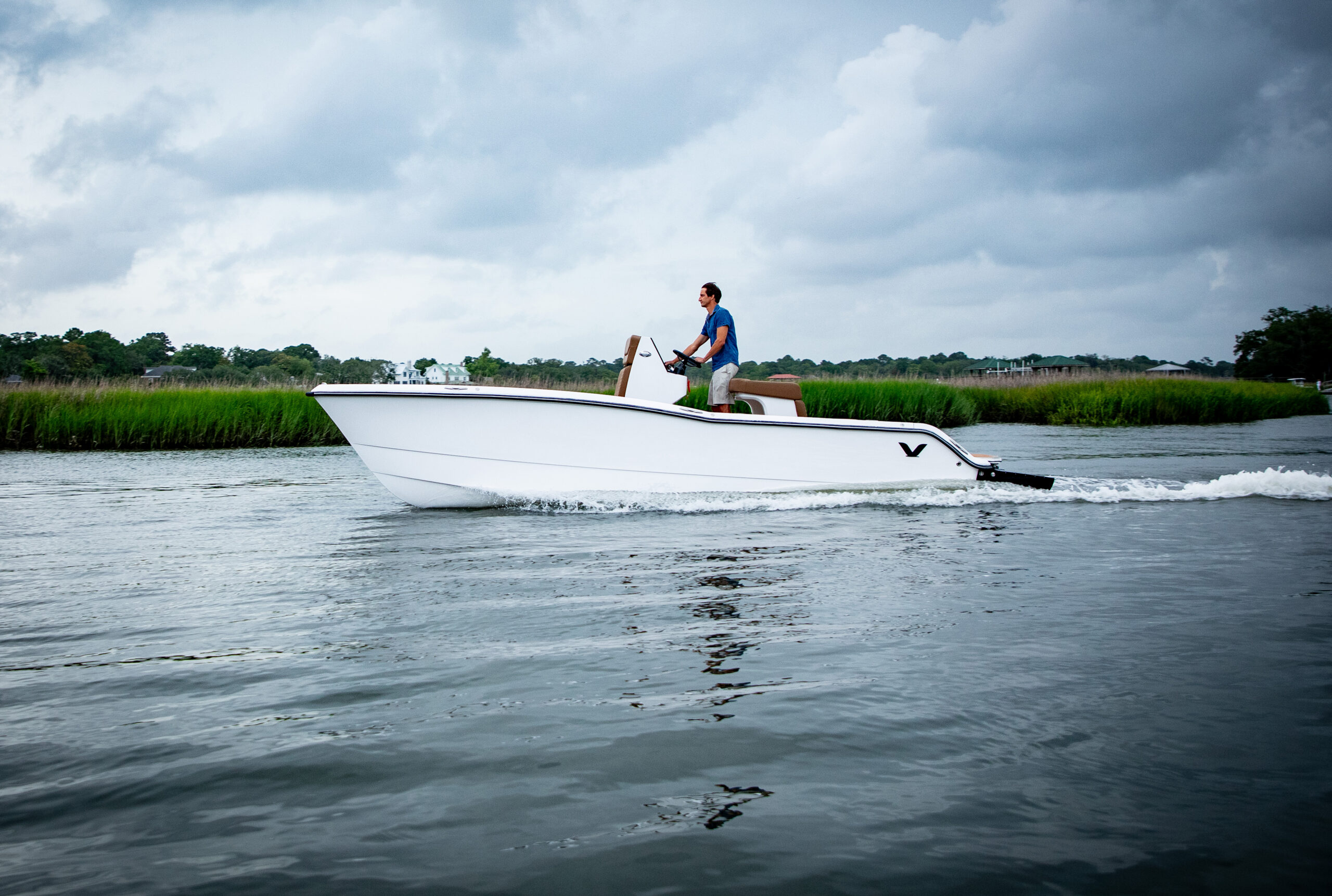
The idea in the minds of Tupper and Matt Moore, Volare’s co-founder and CEO, was to create a low-maintenance electric day boat that would be easy to use, efficient, fast and fun. My first encounter with the Artemis 23 was last year during the Fort Lauderdale International Boat Show. Tupper and Moore rented a waterfront dock outside the show to offer rides to marine journalists.
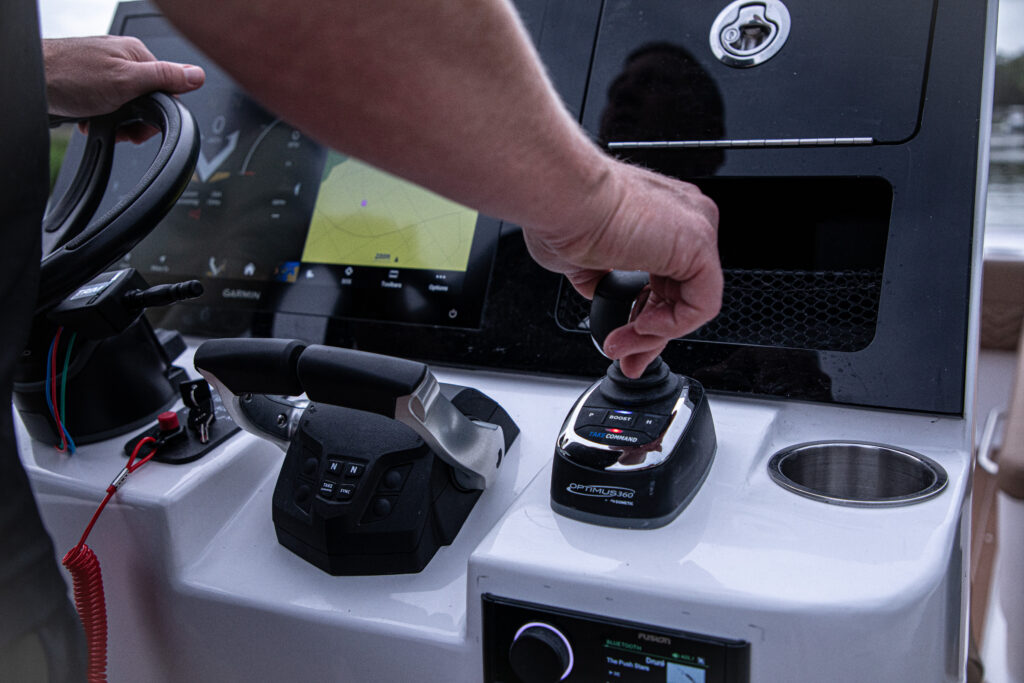
Tupper started showing off the catamaran’s tricks as soon as we cast off the dock lines. A push on the joystick quietly moved the boat perpendicularly off the dock without the use of a bow thruster. Then he twisted the boat within its length using only the engine controls. Next, he navigated the boat sideways up to the dock on the opposite side with ease in a moving current.
Of course, these moves aren’t particularly notable in a world where joystick controls have an ever-growing presence on boats. But it’s the ease and almost complete quietness with which the Artemis makes these movements that are a big deal.
Keeping it Simple
One reason behind the ease-of-use mantra is Tupper and Moore’s desire to build a boat that can be driven by novices, an important feature for boat clubs when it comes time to build or expand their fleets. “We absolutely want those orders from boat clubs,” Tupper says, “and designing the boat to be super-easy to drive has always been at the core of our engineering decisions.”
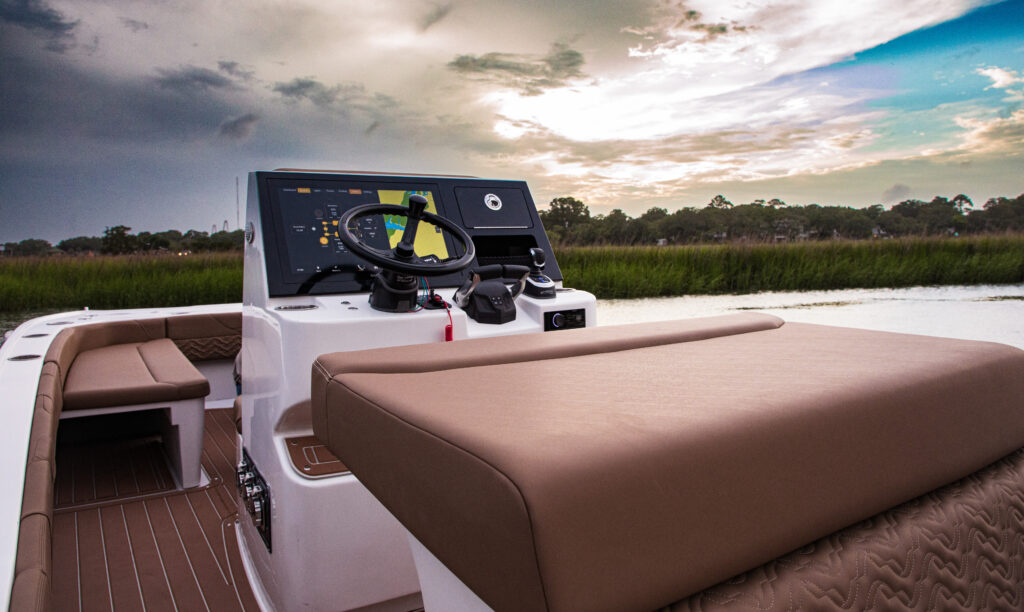
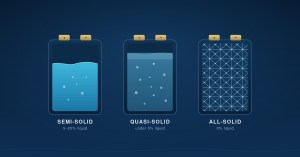
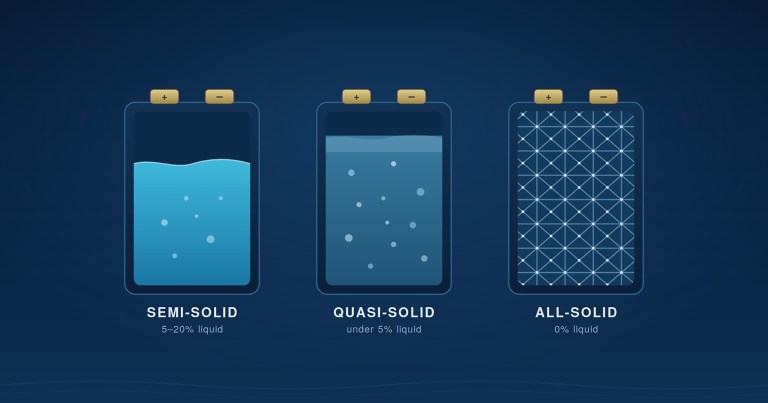
Moore and Tupper also designed the Artemis 23 to need little maintenance. The batteries are off-the-shelf lithium-ion and partial solid-state. They require no plumbed cooling. The drives are sealed and not cooled by water. “Aside from normal cleaning and upkeep and changing a couple of zincs every now and then, there’s not much to do.” Tupper says. “The trailer we pull it around with needs more maintenance than the boat does.”
Performance Matters
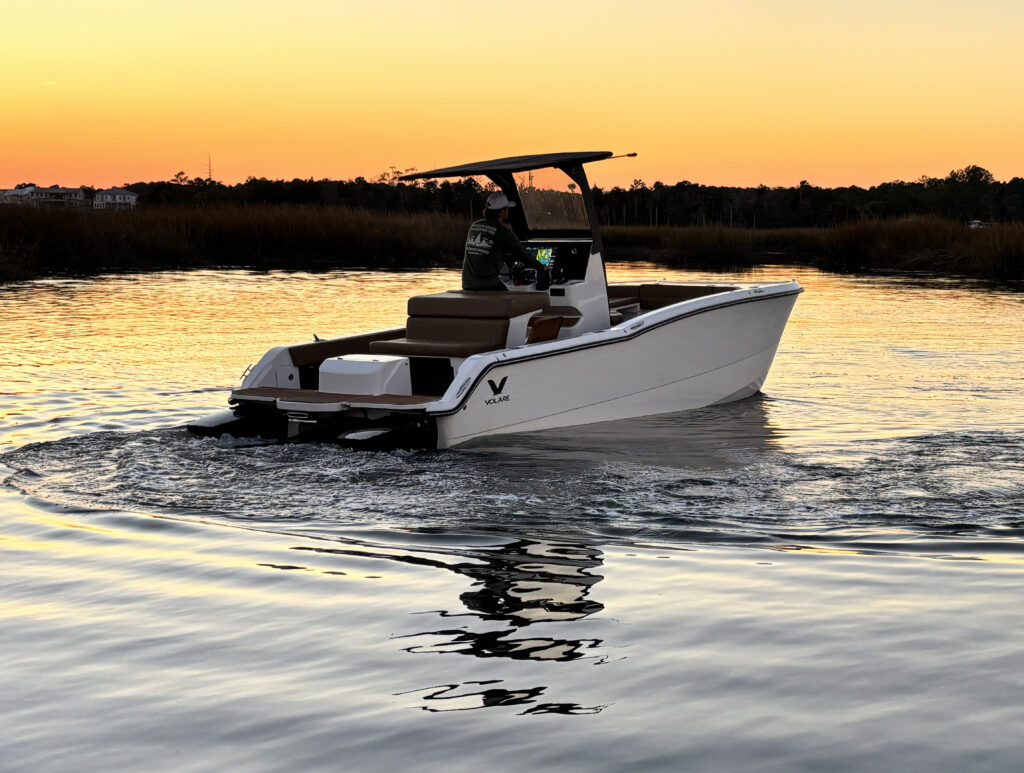
The boat’s performance is enhanced not only by the drives and upgradeable batteries, but also by a hydrofoil that runs in the tunnel between the two hulls. That hydrofoil enhances efficiency, improves performance and provides excellent ride quality. The standard-configuration boat has a top speed of 30 mph and a range of 50 nautical miles at 23 knots. Battery storage is expandable as an option.
As a way to prove the stats, Tupper and Moore took me on a nearly 40-mile loop around local Charleston waters. We put in at Shem Creek and logged the loop through Charleston Harbor, past Fort Sumter, out in the ocean past Folly Beach, up the Stono River, through Wappoo Cut and back to Shem Creek’s boat launch.
After 36.2 miles at an average of 19 mph (nearly two hours’ worth of exploration), we had almost 15% of battery life left. That loosely equates to another 13 miles on the water, according to the Garmin multifunction display at the helm. Recharging to full takes about nine hours with a 50-amp shore-power connection.
Secret Sauce
Another part of the Artemis’ performance is the way the relatively small boat handles big water. During our ocean transit past Folly Beach, we encountered a 3-foot chop from just about every angle. Not once did any of us grab a handrail and gird our bodies for impact.
The experience reminded me of that first ride on the boat off Fort Lauderdale, Fla., where Tupper pointed the bow at 30 mph toward at a huge wake thrown by a sportfish inside the Port Everglades inlet. All five journalists aboard braced as we closed in on the wake, but the boat sailed right over the stir without so much as a tap on the hull. We all looked at one another with disbelief before each taking the helm and trying it for ourselves.
“The foil is the key to making the whole thing work,” Tupper says. “It gets the boat up on the water quickly and rides the hulls up over waves, which improves ride in a chop and decreases wetted surface.”
Scrappy Startup
Moore and Tupper are engineers by schooling and were colleagues at Scout Boats. Tupper was an engineer at Scout, and Moore was a production manager in the yacht division. These were roles the business partners say can be particularly adversarial. “Engineers want their work implemented, and in a timely manner,” Moore says. “Dustin would constantly be bugging me about getting things done, and I was constantly barking back about quality-first being important, which can slow down the line. We definitely had frequent disagreements about how things should have been done.”
Still, they decided to go into the boatbuilding business together. “We both wanted to do our own thing. We’re both passionate about boating, and we have known each other since we were teenagers,” Tupper says. “It felt right from the very beginning.”
Moore adds: “The yin and yang of our relationship at Volare is why we’ve been so successful. Dustin is super-organized and focused — in a good way — while I’m more of the creative mind. My brain is always on, so I can get distracted, and Dustin is great at getting me back on track whether I like it or not. Dustin gets deep in the details sometimes, and I seem to help at coaxing him back toward the light. For this startup-style business, it’s the perfect relationship chemistry.”
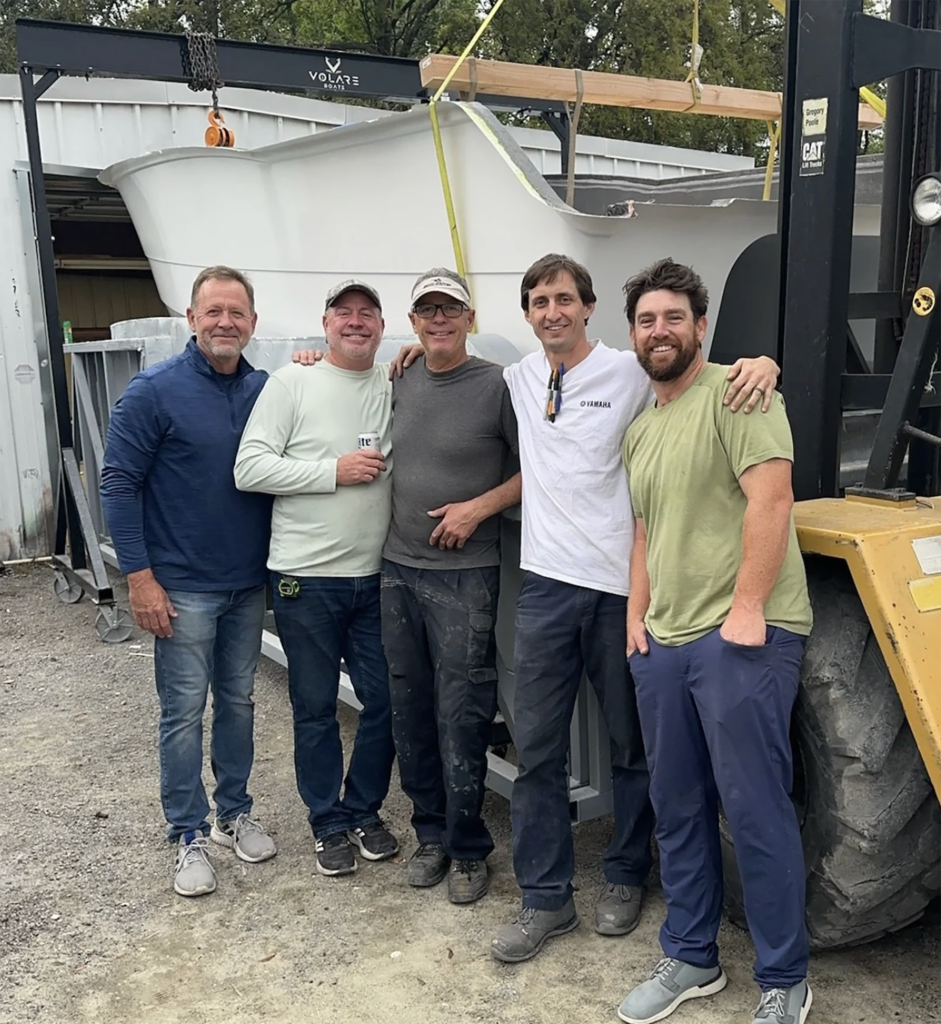
Tupper agrees: “We’re both very good at what we do in very different ways, and we’re constantly checking the other to make sure we’re doing what’s right for the company, our investors, our customers and the boat.”
Tupper and Moore also joined with Florida-based craftsmen Donnie and Charlie Brown of Hydrofly Marine, who helped build the test bed and hull No. 1. The company’s chief technology officer, Brian Robinson, developed and designed the integrated electrical systems aboard the Artemis 23, which uses drives built by RAD in the United Kingdom and from an unnamed manufacturer that has not officially publicized the units yet.
Funding the Idea
Tupper and I spoke at length about how two men in their position — with young families to feed and mortgages to pay — come up with the capital to develop, launch and produce a boat from an idea that started out on paper. “Friends and family helped at first,” Tupper says. “You know, angel investors. Matt’s father-in-law has been very supportive, and there are others. There have also been government small-business grants and similar programs.”
Additionally, Tupper says, the company recently participated in the Catalyst by Beemok event in Charleston, where more than $1 million in funding was handed out. “We got $600,000, and they’re putting a boat in their hospitality marina fleet at The Cooper hotel,” Tupper says. “Keeping investment flowing is almost a 24-hour-a-day job, but it is essential to a small startup like Volare Boats. We also have deposits on several boats that will be the first we build for customers.”
Designed for Durability
As we make our way back to Shem Creek, we (somewhat purposefully, I learn) discover a sandbar and run aground. Moore tilts up the drives and tries to pull us off, but the foil is stuck in the sand. We jostle our weight around in the boat and eventually get off. I’m immediately concerned that we’ve damaged the drives or the foil.
“Oh, that’s nothing as long as it is sand or mud,” Tupper says. “There’s no cooling intake or gearbox in the electric drives, and the foil is heavy-duty cast aluminum. We actually want the boat to be able to survive something like that. It’s good for a regular end consumer and especially a novice who is perhaps renting a boat or using a boat club.”
Another element baked into the construction process of the Artemis 23 is the use of carbon fiber. Inside the building where the boats will be produced, I watch as Tupper, with one hand, lifts the carbon fiber framework for the center console unit and cloth overhead top.
“The whole boat weighs only 3,400 pounds,” Tupper says. “The entire hull is carbon fiber, and the deck uses strategically placed carbon and fiberglass cloths with composite coring. We made one deck completely out of carbon, and I’ve lifted the whole thing out of the mold myself. When you have an electric boat, you have to keep the weight down as much as possible.”
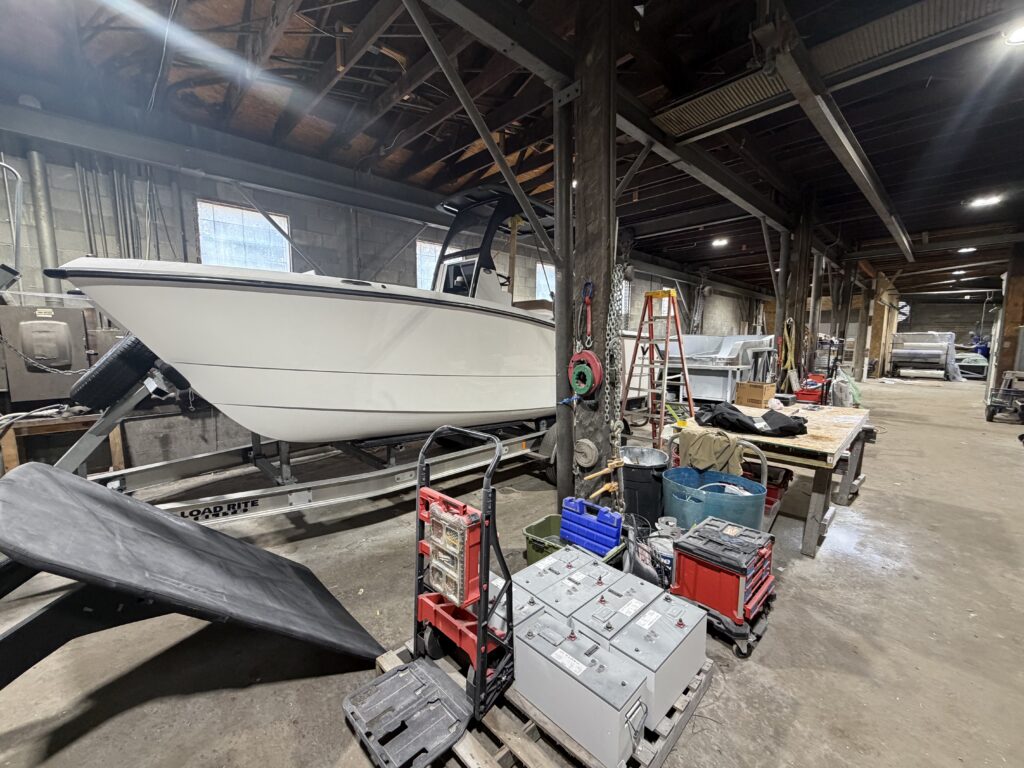
facility, which will have a capacity of up to 100 units per year. PHOTO COURTESY VOLARE BOATS
Tupper shows me how he intends to set up the production line during the next several months. The concept is like most other fiberglass boat production facilities I’ve seen, just at micro scale. Though the facility is unorganized while I’m there, Tupper shows me where materials will come in, how tooling will be placed and parts removed, and ultimately where each Artemis 23 will be fitted out with propulsion, electronics and other components before being shipped.
“We need to get our facility spruced up with an aim toward building boats for our first set of customers,” Tupper says. “Then we’ll ramp up to producing 100 units a year by year’s end. That obviously requires a full-time salesman, so finding that person is also at the top of the list.”
I tell Tupper that, as someone who has a good 25 years on them, doing something like he and Moore are attempting would have scared the heck out of me at their age. “Oh, it can definitely be terrifying,” he says with a chuckle, “but we’re so excited about what we’re doing, and what the future possibly holds makes it worth it.”
This story originally appeared in the April 2026 issue of Soundings Trade Only.