
The Covid-19 pandemic has been, in some ways, an enormous confidence-building exercise. Companies worldwide — the ones that survived, at least — went through an endurance test that left them keenly aware of their capabilities, helped them strengthen their soft spots, and launched them into 2023 with a can-do attitude, even with all kinds of storm clouds gathering on the horizon.
Inflation, supply-chain kinks and the continuing war in Ukraine continue to be serious concerns, but numerous companies with a global presence for exports are reporting optimism at the start of 2023. They expect to have new products ready for consumers to check out this year at in-person boat shows, and they are still seeing consumer demand across all price points, albeit with slowing demand at the entry-level end of the market, where sensitivities are highest to inflation and rising interest rates.
As the new year gets fully underway, here’s a look at what corporate leaders are thinking about from Canada to the United Kingdom to Europe.
 Ingo Bartussek
Torqeedo
Torqeedo is based in Munich, Germany, where it manufatures electric and hybrid propulsion systems. In early January, a national survey showed the primary issues of concern among German citizens were the war in Ukraine, followed by energy policy, climate protection and inflation. Worries about energy and climate have always been in Torqeedo’s wheelhouse, given that its products are intended to address those problems by reducing the use of fossil fuels. Consumer interest in electric boats and emission-free drive systems is “exploding,” according to Tess Smallridge, manager of marketing communications for Torqeedo, which spent the past year strengthening its product lineup and improving production capabilities, as well as internal processes.
“Our brand-new production facility allowed us to implement lean manufacturing strategies and ready the company for sustained, rapid growth,” she says. “We continue to innovate and expand our offerings on board while also considering the factors that can impact the adoption of sustainable boating that lie beyond the boat, like charging infrastructure and electric-boat training for service technicians.”
 Applezoomzoom - stock.adobe.com
Prior to the Ukraine war, a substantial amount of Germany’s natural gas, coal and oil was imported from Russia. Inside Germany, Smallridge says, the ongoing war has crystallized the danger of reliance on fossil fuels and the inherent instability it introduces into the economy.
There also are concerns about a labor shortage, with older German workers retiring and not enough younger workers entering the workforce to make up the losses. “At Torqeedo, we are lucky,” she says. “People want to work for a transformative company working on sustainable products, and we are committed to European sourcing and ethical German manufacturing.”
All across Europe, she adds, people want to see the war in Ukraine resolved, not only for reasons of peace and safety, but also because a resolution will help to buttress consumer confidence amid other challenges. Globally, she says, “the climate news is not good,” with 2022 being another record year for fossil-fuel emissions and reports showing that continued action is needed. “As the climate crisis worsens and the search for solutions intensifies, the marine industry should be prepared to offer emission-free recreational boating,” she says. “The boaters of the future want recreational activities they can feel good about.”
 Cavan
CavanVision Marine Technologies
Boisbriand, Quebec-based Vision Marine Technologies also specializes in electric-boating options. More interest hikes were expected in the country after an early January report showed near-record-low unemployment and a Canadian job market that experts described as “still running at an unsustainable pace.”
But demand for the product keeps coming, according to Vision CEO Alexandre Mongeon. He says the company recently received its first order from Europe’s biggest boatbuilder, Beneteau, which has been testing Vision technology on one of its boats for the past year. “They’re very happy with the result,” Mongeon says. “The scope is getting much more product offerings with electric in 2023.”
He’s expecting about $30 million in sales of electric outboards for 2023. By 2030, he says, “We’ll have probably about 20,000 outboards sold every year.”
 Michael J. Berlin
Inside Canada, he says, the government spent the past few years helping to ensure availability of the types of batteries and parts Vision Marine needs, so his company didn’t suffer as much from the production issues that plagued most companies worldwide. With that said, the Canadians are not assuming that readily available parts will continue to be the case. “We’re working with [the government] to develop some local solutions for our technology, and we might have some good news about that in the next month,” Mongeon said in mid-December. “We’re not worried about labor; we’re more worried about education that we have to supply to the market. It’s more an education problem that I have than a manufacturing issue.”
The collapse of in-person boat shows during the Covid-19 pandemic hit his company particularly hard, he says, because those shows are the primary place where industry executives, as well as consumers, can learn about the new types of propulsion that Vision Marine manufactures. Without being able to see and touch and experience the technology, he says, buying an electric boat or propulsion system doesn’t make sense to a lot of people, but at a boat show, the education opportunities are endless. “It’s there. It’s not a prototype. It’s under construction,” he says. “Once you try it, the mind opens.”
In addition to eagerly anticipating the return of in-person boat shows in all markets, Mongeon says he also hopes to see big-name brands that Americans trust coming out with electric-propulsion products in the near future. That, too, would help with the education issue that he sees as his company’s primary barrier to even faster growth.
 Westock - stock.adobe.com
“The best thing that could happen would be for Mercury or Honda to offer something electrical and powerful,” he says. “That would be helpful. Then the industry would feel more confident. It would expose and teach the industry about the technology.”
Azimut Yachts
Azimut Yachts is based in Italy, where inflation reached a 37-year high in 2022. Prices spiked more than 8% from 2021 to 2022, the largest jump Italians have seen since 1985, when the national currency was still the lira. That’s not good news, but it’s also not a significant headwind for parent Azimut-Benetti Group, since Italy is not the company’s primary consumer market for boats. It exports worldwide, so much so that Azimut-Benetti has been named the global leader in larger-yacht orders for 23 consecutive years. Group CEO Marco Valle says the company is looking forward to continuing that success with the Azimut Grande 26M, Azimut Grande 36M and Azimut Magellano 30, all of which he says “will be in America soon.”
When Valle looks at the economic landscape across Europe, he sees the past year’s inflation spike as a primary concern. “This has affected not only our industry, but the whole economic situation,” he says. “The inflation rate is now touching human beings more than companies. It’s energy and goods.”
 Murac Gocmen - stockadobe.com
While Valle says he does not anticipate full-on labor strikes across Europe in response to reduced consumer purchasing power, he does anticipate a “social situation that is going to arise,” since salaries are not keeping pace with inflation. Azimut-Benetti gave bonuses to key employees in 2022, attempting to help stave off that problem.
“I think that we have reached the peak of the inflation rate from a production point of view,” Valle says. “I don’t know about a social point of view. We have seen, on the entry-level boats, that there is a bit of slowing down. We are trying to understand if it’s slowing down because the price is higher or the people are a little bit afraid of the economic situation or the wait is so long [on new orders]. For an Azimut 53, the wait is 24 months. It used to be, in this period, you could order it for the summer 2023. Now the wait is until summer 2025. It’s something that is scary, a little bit.”
With the bigger boats that Azimut-Benetti builds, he says, those problems are nonexistent because large-yacht buyers expect a delay between ordering and delivery. Even prior to the pandemic, custom superyacht builds routinely took three years or longer from design to launch. “Psychologically, you are inclined to wait anyway. It’s part of the process,” Valle says.
In addition to inflation issues, supply-chain problems continue to persist. “In the last year, we have been suffering with a shortage of materials,” he says, adding that he’s seeing improvements now with raw materials such as steel, aluminum and copper. “At the current time, the supply is getting better, but with higher prices than before and with timing that is not 100% accurate. But at least it’s coming.”
Sunseeker
In Britain, where Sunseeker is based, early January predictions were for a recession almost as deep as Russia’s. Goldman Sachs forecasted a 1.2% contraction in U.K. real gross domestic product for 2023, and the U.K. independent Office for Budget Responsibility forecasted that the country is facing its sharpest fall in living standards on record.
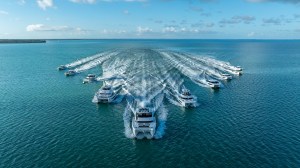
Even still, the order book is fat at Sunseeker, which exports 98% of the boats it builds. The company is planning to display the new Superhawk 55 at the Discover Boating Miami International Boat Show in February. “We have had a great 2022 and have a forward order book of over £600m [$725.673 million], equal to two years of annual turnover,” CEO Andrea Frabetti says. “We have recently outlined our new-product development strategy for the next three years, until 2025, with 12 new models being launched and an expansion of the Sunseeker portfolio to 22 yachts. Sunseeker has also committed £40m [$48.37 million] for new-product development and production capability — a record investment for the company.”
Specific to the United Kingdom, he says, supply-chain issues continue to be a concern. “Certain materials and equipment are hard to source, prices are rising, and delivery dates are far from certain,” Frabetti says, “but we have adapted to these times like all boatbuilders. Instead of suppliers pushing what we need to us, we are now pulling in what we need from them.”
The company continues to keep a watchful eye on all kinds of components and markets. For instance, he says, in the past year, electronics prices rose substantially because the cost of microchips soared. The war in Ukraine led nickel prices to peak, which affected the stainless-steel market. “All these issues are flagged weekly, and we monitor and keep up-to-date on issues we see impacting so that we can mitigate and be prepared for any challenges,” he says.
But, Frabetti adds, as with boatbuilders worldwide, “our key focus remains on delivering our yachts to the very highest standards, utilizing quality supplies and retaining our first-class, skilled team.”
This article was originally published in the February 2023 issue.